
Working in Bahrain: flexible permits, self-sponsorship and residency
Updated August 2026
Bahrain is the only Gulf state that lets some foreign workers sponsor themselves. The Flexi Permit and Golden Residency both break the link between your job and your right to stay.
Quick answer
This guide covers 3 main routes into Bahrain for work or residence. The primary one is the Standard work visa route, with a processing time of 2–6 weeks. A one-bedroom in central Manama costs about $800 a month, against an average net salary of $2,100. The requirements, fees and timings below are a snapshot reviewed on August 2026; confirm each one with the official immigration authority for Bahrain before acting.
At a glance
Rent, 1-bedroom (centre) — Manama
$800
Average net salary — Bahrain
$2,100
Processing time — Standard work visa
2–6 weeks
Standard employment still runs through employer sponsorship via the Labour Market Regulatory Authority. What sets Bahrain apart are the alternatives: the Flexi Permit, which allows eligible workers to work for multiple employers without a sponsor, and Golden Residency, which grants indefinite renewable residence based on income, property or talent.
Main visa routes
Standard work visa
Employees sponsored by a Bahrain-registered employer through the LMRA. Typically valid two years and renewable.
Golden Residency
Residents of five years with a qualifying salary, property owners above a threshold, retirees with pension income, and recognised talent. Indefinite renewable residence with the right to work and sponsor family.
Flexi Permit
Eligible workers already in Bahrain who wish to work without a single sponsor, across multiple employers. Renewable in one- or two-year terms.
What you need
- LMRA work permit obtained by the employer, or a Flexi Permit application
- Attested qualifications for professional and licensed roles
- Medical examination at an approved centre
- CPR (Central Population Registry) card registration
- Compulsory health insurance contribution
- Professional licensing through NHRA for healthcare roles
Residency & legal framework
Permanent residency
Golden Residency is the closest thing to permanent status in the Gulf: indefinite and renewable, it survives a change of job and covers your family. It is the main reason Bahrain appeals to people who want Gulf income without Gulf precarity.
Citizenship
Naturalisation requires long residence — commonly cited at 25 years for non-Arabs and 15 for Arab nationals — plus Arabic proficiency, and remains discretionary and rarely granted. Do not plan around it.
Legal rights
- Flexi Permit holders work without a sponsor and may change employers freely.
- Golden Residency survives loss of employment and covers dependants.
- Foreigners may own freehold property in designated areas.
- Bahrain does not permit dual nationality for naturalised citizens.
Labour law essentials
- 48-hour week, 36 during Ramadan for Muslim employees.
- 30 days of annual leave after one year of continuous service.
- End-of-service gratuity is payable on termination of the contract.
- The LMRA regulates permits and handles worker complaints.
Cost of living breakdown
Monthly averages for one person in Manama, in US dollars.
| Category | Per month |
|---|---|
| Rent, 1-bedroom (centre) | $800 |
| Rent, 1-bedroom (outside centre) | $550 |
| Groceries | $270 |
| Utilities | $110 |
| Health insurance | $95 |
| Public transport pass | $45 |
| Internet | $55 |
| Core monthly total | $1,375 |
Job market & qualifications
High-demand industries
- Banking and financial services — the Gulf's oldest finance hub
- Fintech and regulated digital finance
- Aluminium production and heavy manufacturing
- Healthcare and private clinics
- Hospitality, retail and logistics
Degree recognition
Attestation through your foreign ministry and the Bahraini embassy is required for professional roles. Healthcare licensing runs through the NHRA with an examination and verified experience; engineers register with the Council for Regulating the Practice of Engineering Professions.
Average wages
Salaries are tax-free but sit below Qatar and the UAE. Finance professionals earn BHD 800–2,500 a month, engineers BHD 700–1,600, healthcare staff BHD 700–1,800. Living costs are the second lowest in the Gulf after Oman.
Life quality: pros & cons
Housing market
Manama rents are moderate by Gulf standards and typically paid monthly. The island is small enough that commuting is short from almost anywhere, and many residents commute to Saudi Arabia over the King Fahd Causeway.
Language requirements
Arabic is official and English is very widely used in business, banking and healthcare. Bahrain is among the easiest Gulf states to operate in with English alone.
Integration tips
Your CPR card is the key document for banking, healthcare and housing. Bahrain is generally regarded as the most socially liberal of the Gulf states, with a long-settled and diverse expatriate population.
What works
- Flexi Permit and Golden Residency allow life without an employer sponsor.
- Tax-free income with living costs well below Dubai or Doha.
- Established financial sector with genuine career depth.
- The most socially open environment in the Gulf.
What to weigh
- Salaries are lower than in Qatar, the UAE and Saudi Arabia.
- A small job market limits senior-level opportunities.
- Citizenship remains effectively closed after decades of residence.
- Bahrainisation quotas apply to many private-sector roles.
Photo credits
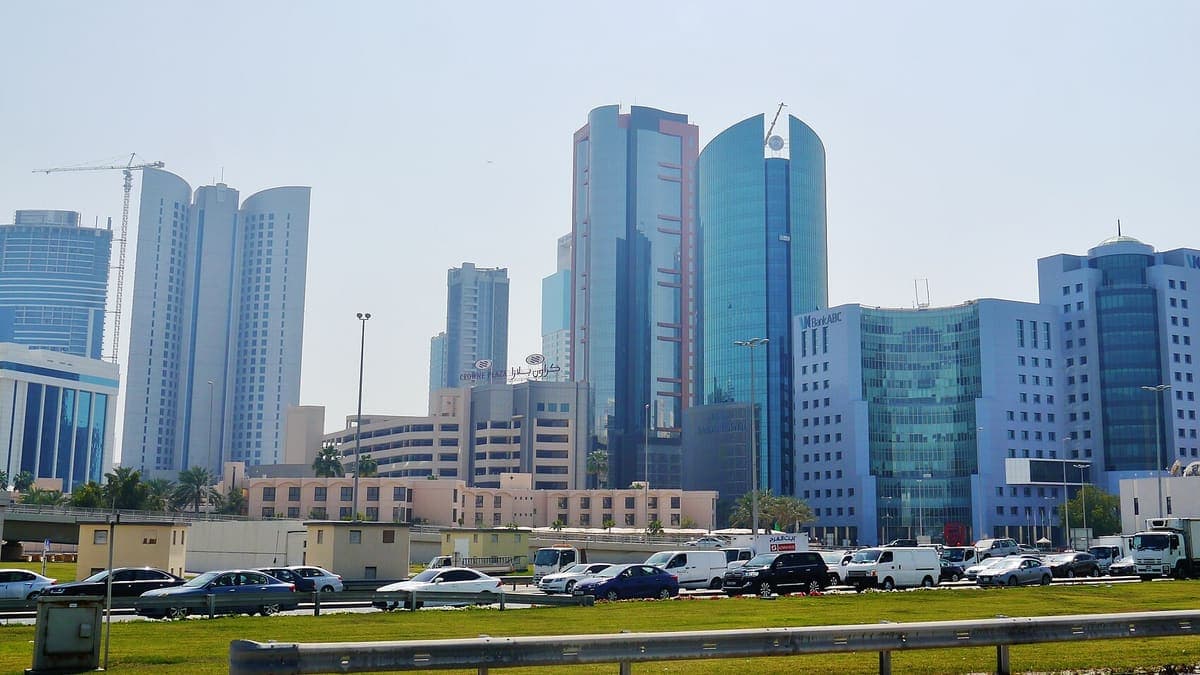
- Manama — Zairon, CC BY-SA 4.0
Compare living costs with your country
Other guides in Gulf
Compare visa routes and living costs across the region.



This is general information, not legal advice. Always confirm details with the official immigration authority before applying.